I recently started “studying” Math again. Why? I had some free time on my hands after what felt like ages. Parenting an energetic toddler, a full-time job, and managing a full life hardly leaves any time for oneself. I decided to pick up things from college which I haven’t done justice to: Probability & Statistics, Economics and Game Theory.
I asked chatGPT to design a curriculum for me, and it suggested I brush up basic algebra and calculus first. I turned to Khan academy for it, and it was surprisingly good! It felt nostalgic - studying equations and basic functions again. Trigonometry, Matrices, Complex numbers, the different “geometries”.
As a 33 year old, getting back to solving equations and graphing them felt good. Selecting a notebook from my stash, making sure it was fountain-pen friendly, inking up a couple of pens - made me feel like a kid again.
I rediscovered why people say “Math teaches you logic”. As an adult doing the problems, maybe 80% was instinct. But I really had to go back to basics (and relearn) to make the remaining 20% work - the mental gymnastics of justifying proofs is a special skill that one tends to just forget.
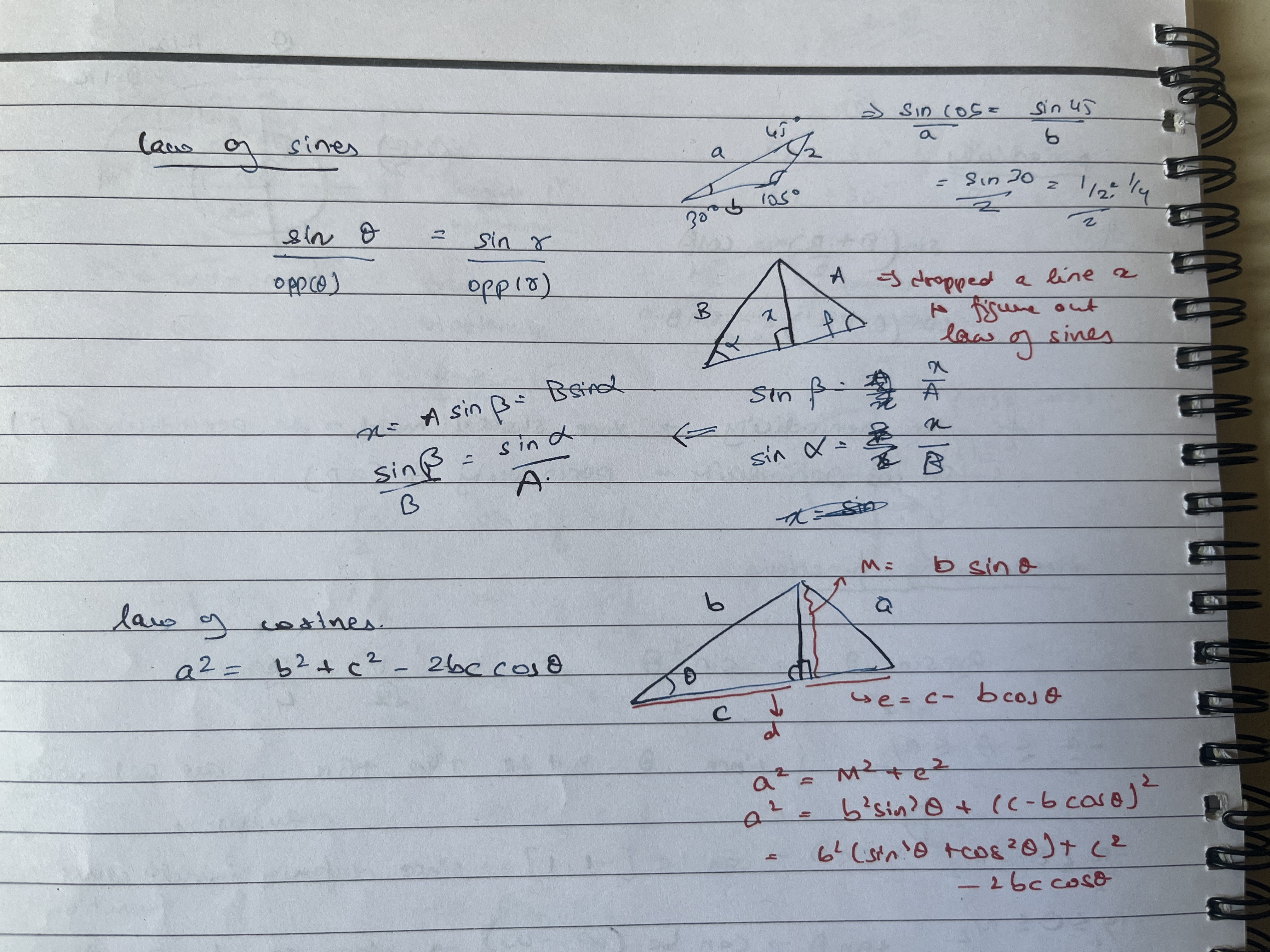
Breaking down basic equations was straightforward, almost mechanical - but when the same equation is presented as a word problem - I blanked out. I felt more than a little embarrassed when I had to resort to hints to make progress when I first started. Words like first principles thinking, problem framing and “make it visual” - were ringing in my head as I struggled to finish those pesky word problems.
I loved discovering how matrices are fundamental to image processing as well as the entire LLM world today (and discovered 3blue1brown in the process). My mind was blown with complex numbers and polar geometry. And Euler as a polymath genius is a rabbithole I have yet to fall into. I hope to find time to keep diving deeper on all three.
And much to my dismay - it seemed like not a lot had changed in the past 20 years. I was stumbling on the same problems that tripped me while at school (e.g. if A takes 8hrs to dig a hole, and B takes 6hrs, how much time will they both take together?) How had I not developed any intuition for these problems, despite doing a full engineering degree + a full-time MBA, is beyond me.
Which raises the question, that younger readers may ask (and a lot of us still do too) - where do we use math in daily life?
My answer would be a little tangential, and perhaps a bit exaggerated and / or extrapolated - Math teaches you how to think, how to persevere, and how to find joy in the steps (“show your work” anyone?)
First Principles problem framing. To solve some of the more hairy problems, I had to go back to “units” (holes dug / hr or hrs taken / hole). This is as simple as talking to yourself in your own language - and really chalking out what the bloody problem is asking you to do. Many of us have forgotten this skill in our daily life - coming down to absolutely First Principles 1 to look at the bones of something we’re struggling with.
Building on this - graphing an equation is the first instance of “make it visual”. Being able to visually depict something instantly simplifies the toughest of problems - whether on pen/paper, or on a computer screen, or even in your head. Now, math comes with “built-in templates”
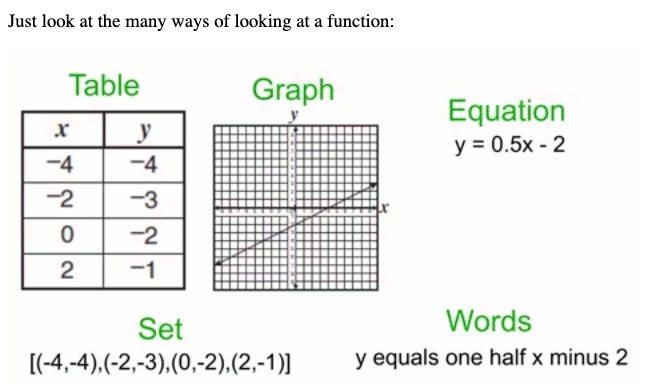
Maybe life isn’t that simple. But one can try. We are trying to figure out what S will do in his summer holidays (toddler parents will know the dilemma). What started off as trying to find a good summer camp (single variable?) is now a multi-variate equation - juggling calendar schedules (his own, and his on-call butlers aka Mom and Dad), his interests and ours, distance from the house, visits to and from daadi ghar and naani ghar, and general down time - he is just 4 after all.
Another important thing Math teaches us - Perseverance, and sticking to a problem. It’s very easy to say “too hard” and give up. Or, we tend to externalise - we blame people or situations. Most of the time, if you just sit with the problem for a bit - or even let it play around in your head for hours, days (or maybe months) - you will see a way out. And if nothing else, asking for help is perfectly acceptable. What is not acceptable is giving up.
Sometimes, just sometimes - there is no “acceptable” answer for a problem (No, I am not contradicting myself). You may remember this from solving quadratic equations - you can get 1 or 2 solutions since it’s a 2nd degree polynomial. However, the answers may not be “real” - they are complex (imaginary) numbers, and while you followed the due process (show your work!) - you’re left feeling cheated.
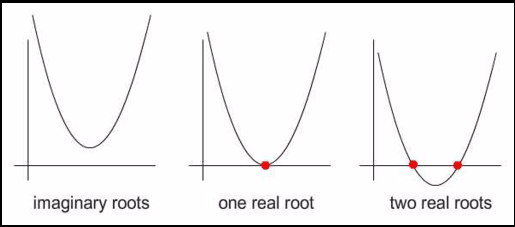
Sometimes, life may be like that. You may do everything right, but things may not eventually work out. What does one do with something like this? For now, I’m content to take it at face value and move on.
I will probably forget most of this soon - after all, I really do not use most of this in “daily life”. However, as S grows up and starts to wrestle with Math and Physics and Chemistry for the first time - I hope to maybe learn again with him, and find more joy, lessons and connections.
PS: A word of appreciation for Khan Academy - for making this whole thing very approachable. Go to the Math section, scroll down to get to the college / senior level courses, and have fun!
Footnotes
-
Incidentally, also the name of the Ken’s Podcast and Newsletter which I enjoy immensely. One of the few quality (and non-controversial) ones they put out. ↩